Salon Secrets
Goddess braids: what to ask for before you book
The salon secret to getting goddess braids right is agreeing on the details, from how much curl you want to who supplies the hair.
By Eleanor Marsh, Roots & Grey Coverage Editor
Published · 6 min read
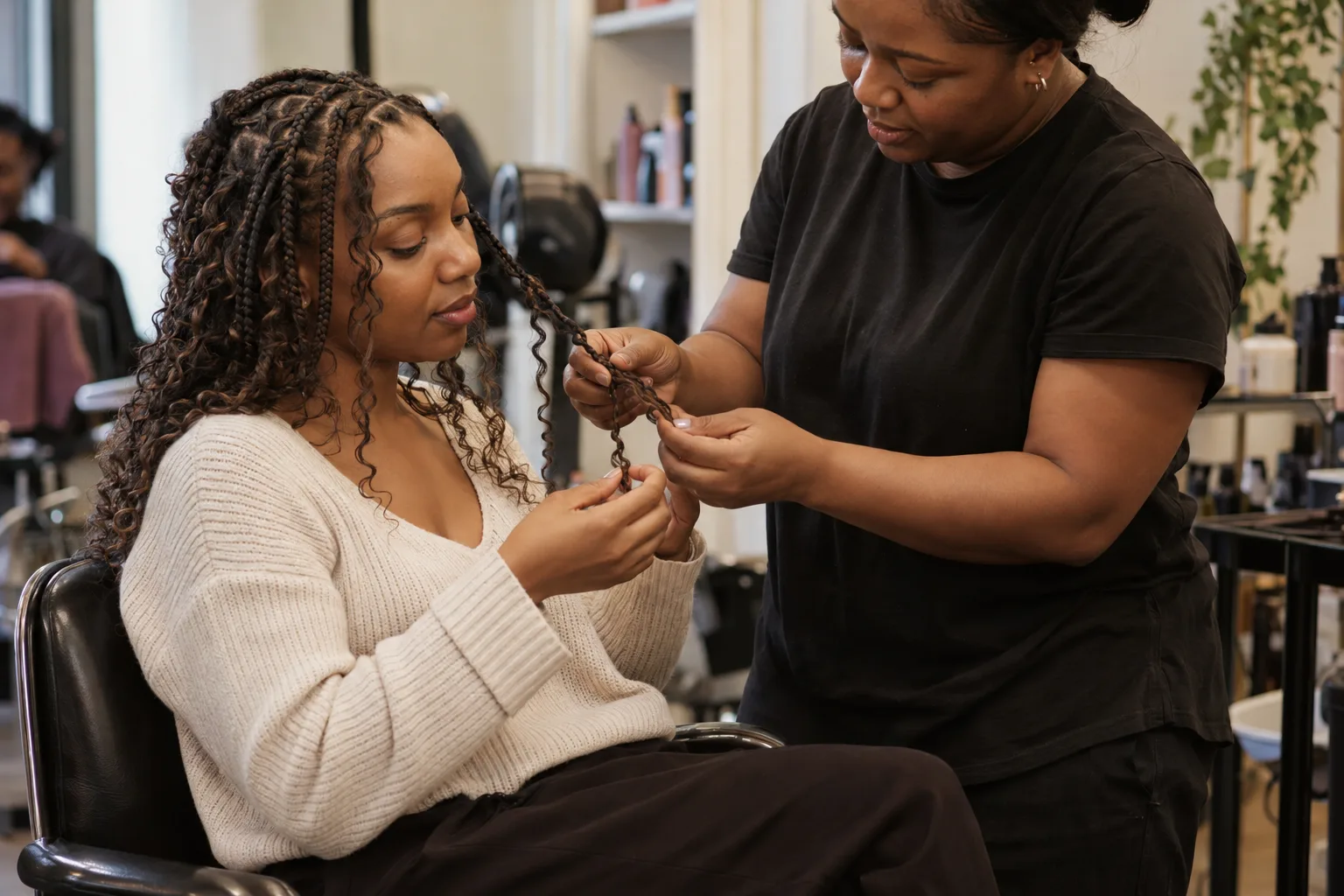
Quick answerGoddess braids combine individual plaits with loose curls, often using a knotless technique. Because braiders use the name differently, agree on braid size, curl placement, hair type and the full price before booking.
Goddess braids come with a booking detail worth knowing: the name does not mean quite the same thing in every salon. Braiders describe different balances of loose curls and defined plaits, meaning two appointments booked under the same name can produce noticeably different finishes.
For us, the appeal is the contrast: orderly braids with curls that move independently through the lengths. But choosing the look involves more than saving a photograph. The amount of loose hair changes both the silhouette and the work involved at home, while the extension material affects the bill and your styling options.
What happened
The useful distinction is not necessarily goddess versus boho. In interviews with Allure, London braider Jess Rutana and New York braider Susy Oludele described almost opposite approaches to those labels. Rutana associates goddess braids with more loose hair and less visible braiding; Oludele describes a more defined braided finish with fewer curls, reserving the fuller effect for boho styles.
That difference makes a visual consultation more useful than relying on a service name. Show your braider the exact feature you like: curls around the face, waves scattered through the lengths or a finish in which loose hair largely conceals the plaits. A photograph can contain all three, but you may only want one.
Make the reference picture specific
Take a front view and, if possible, a side or back view of your preferred style. The front alone cannot show how densely curls are distributed behind the shoulders. Point out the braid thickness separately from the overall fullness; lots of loose hair can make fine braids look much more substantial.
Our pick for a clear starting brief is visible plaits with deliberately placed curls, rather than simply requesting maximum volume. It makes the balance easier to discuss and adjust before installation. There is no single correct proportion: a curl-heavy finish is equally valid, provided you have chosen it intentionally.
The background
The knotless version starts with your own hair, with extension hair fed into the braid as it progresses rather than secured in a prominent knot at the root. Curly strands are incorporated along the way. That construction is what allows a structured plait and an unbraided curl to sit together within the same section.
Preparation generally involves cleansing, conditioning and stretching or blow-drying the natural hair. Check the salon's instructions before doing this yourself: some appointments include preparation, while others require you to arrive ready to braid. Avoid assuming that the advertised appointment covers every stage of the service.
Choose the material before the colour
Human hair, synthetic hair and combinations of the two can all feature in this style. Ask what will be used for the braids and what will be used for the loose sections; those need not be the same material. Synthetic-only options generally cost less, but price alone does not explain how the curls should be maintained.
Heat styling needs a separate conversation. Synthetic fibres vary in their heat tolerance, so do not assume a curling tong is suitable. Human-hair extensions also need care instructions. Ask your braider how to refresh the exact texture being installed, rather than buying tools or products on the strength of a hairstyle name.
Colour offers another way to change the effect without dyeing your own hair. Extensions close to your base shade create a more continuous finish; contrasting curls make their placement more obvious. Compare the braiding hair and loose hair together before installation, especially when combining different materials, because matching shade descriptions do not guarantee an identical appearance.
Braid size is a separate decision again. Small braids give a finer pattern, while the in-between size often called smedium sits between small and medium. Larger sections generally mean fewer individual braids to install, although length and the amount of curly hair also influence appointment time.
What people are saying
New York braider Shanna St. Cyr Alexander points to versatility and extra dimension as part of the style's appeal. That translates into something practical: the same set can show its sectioning when gathered up, then look softer and more textured when worn down. You are choosing both a braided pattern and a loose-hair finish.
The price discussion needs geographical context. Oludele gives a US estimate of $300–$500 for goddess braids, with the hair used and local market affecting the total. That is not a UK price guide, and converting it into pounds would not produce a reliable quote for a British salon.
Instead, request an itemised total for your chosen length, braid size and curl density. Confirm whether hair is supplied, whether preparation is included and whether any deposit is deducted from the final bill. If you must bring hair, get the required type, length and quantity in writing before shopping.
Rutana's maintenance advice puts particular emphasis on the loose human-hair strands: separate them gently, then detangle from the ends upwards while supporting the hair near the braided section. The important distinction is that neatly plaited lengths do not make the unbraided pieces maintenance-free.
We would treat that care requirement as part of the booking decision, not an afterthought. Someone who enjoys refreshing curls may welcome a fuller finish. If your morning routine needs to be brief, ask what a version with fewer loose pieces would look like and how its upkeep would differ.
What happens next
Before leaving the chair, ask for a demonstration on one loose section. Have your braider show you how to separate it, which tool suits the curl pattern and how much styling product to use. Watching the method on your actual extensions is more useful than trying to adapt a routine intended for another texture.
Keep the curls separate from the plaits
When detangling at home, isolate the loose hair rather than dragging a brush through the whole style. Support each section and work through the ends before moving upwards. Stop and separate a snag with your fingers instead of pulling it through the surrounding braids.
A suitable leave-in conditioner can help refresh loose human-hair curls, while a compatible serum can add shine and smooth the surface. Start sparingly and follow the hair supplier's guidance. Adding more product is not a substitute for separating tangled strands, and heavy layering can leave the finish coated.
For washing, agree a routine that suits your scalp, activities and extension material. Work carefully between the sections, rinse thoroughly and allow the style to dry fully. Avoid vigorous rubbing through the loose lengths, which can encourage tangling; leave enough time for drying rather than washing immediately before bed.
At night, loosely gather the lengths into sections and use a satin scarf or bonnet that accommodates them without cramming the curls together. Loose twists or plaits can help organise the hair. The aim is to reduce rubbing and overnight tangling, not to flatten every curl into submission.
For daytime styling, a low ponytail gives a different outline without piling all the length on top of your head. A half-up arrangement leaves the curls visible below. Use a fastening large enough for the gathered braids and avoid forcing a small clip around more hair than it can hold.
Finally, discuss removal when you book. Oludele recommends taking braids down after six to eight weeks; treat that as a planning window rather than a promise of pristine curls throughout. Allow time to undo each plait and gently separate the loose hair, rather than leaving the entire job to a rushed evening.
Related: Verity's brunette waves: two looks to take to the salon
Related: Autumn bob haircuts 2026: choose the shape, not the label
Why this matters
For UK readers, the most useful salon question is what the quoted service actually includes. A lower starting price may exclude the hair or preparation, while a fuller finish can mean more curl care at home. Ask your braider to match the look to the time you can realistically spend maintaining it, and confirm the total in pounds before paying a deposit. A clear brief gives you something concrete to agree on: the finish, the materials and the routine that comes with them.
Common questions
- What are goddess braids?
- Goddess braids combine individual plaits with loose curly strands, often using a knotless technique. The curls are incorporated during braiding, and their amount and placement vary with the desired finish.
- Are goddess braids and boho braids the same?
- The names overlap, but braiders do not use them consistently. Some call the curl-heavy version goddess braids; others call it boho. Agree on a reference photograph rather than relying on the label alone.
- Do you need human hair for goddess braids?
- No, goddess braids can use human hair, synthetic hair or both. Ask which material will form the plaits and which will form the loose curls, as each may need different care.
- How much do goddess braids cost in the UK?
- You need a salon-specific quote in pounds. Length, braid size, curl density and hair type affect the total; check whether extension hair and preparation are included before paying a deposit.
- How do you stop goddess braids getting tangled?
- Gently separate the loose strands and detangle from the ends upwards, supporting the hair near the braid. Use tools suited to the curl texture, and loosely organise the lengths under a satin scarf or bonnet overnight.
- Can you use heat on goddess braids?
- Only if the extension hair is suitable for heat styling. Synthetic fibres vary in heat tolerance, so check the supplier's instructions and ask your braider how to refresh the curls before using a tong.
- How long should you keep goddess braids in?
- Braider Susy Oludele recommends removal after six to eight weeks. Discuss timing with your own braider and plan for careful takedown; that window does not guarantee the loose curls will stay pristine throughout.
About the writer
Eleanor MarshRoots & Grey Coverage Editor · Bath
Eleanor writes about grey roots, blending and smart colour upkeep.
More from EleanorSources
This article is original reporting by The Colour Edit based on the sources above. Last reviewed 9 October 2026. Product mentions are editorial unless clearly marked as sponsored.